









🔊 Cook mode: big steps, timers and voice control (say “next”), hands-free.
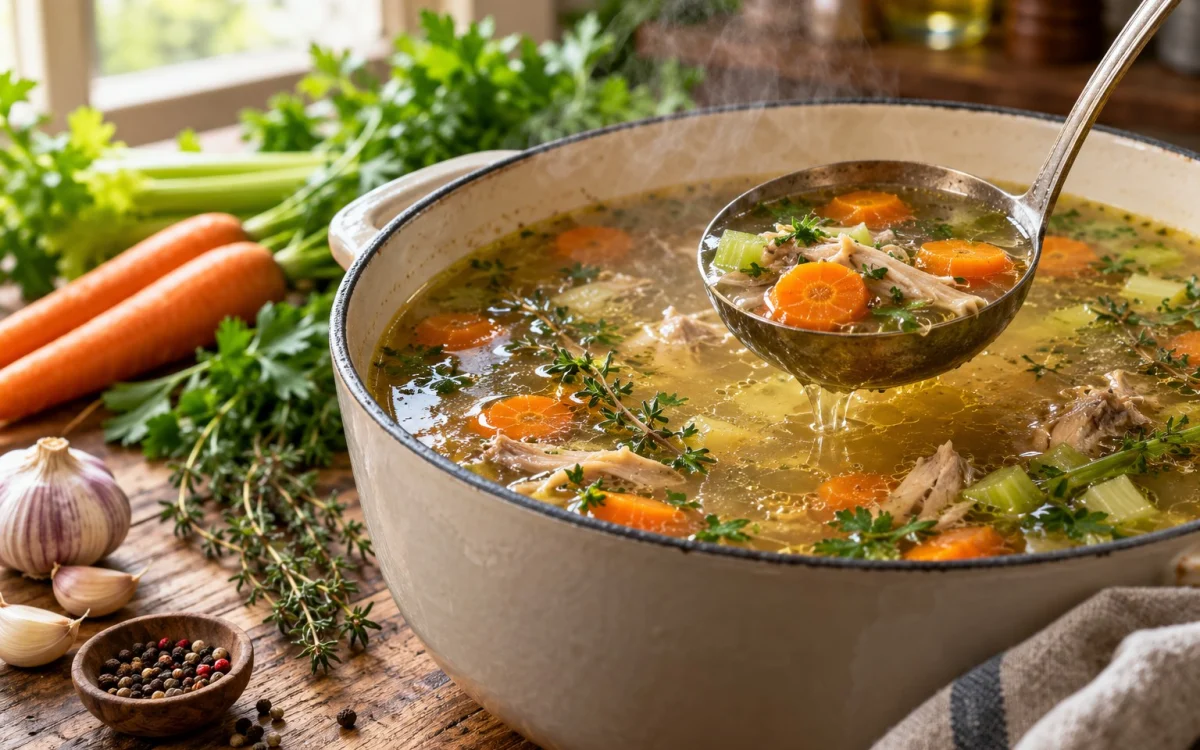
Bone broth is a slow-simmered soup of bones, vegetables and aromatics, and many people make it at home for warmth and simplicity. It is also one of the most heavily marketed foods online, so this article does two things: it gives you practical tips for making a clear, well-flavoured broth, and it separates what bone broth actually offers from what is often claimed. The ingredients and method are in the recipe card above.
Why it works
- Blanching first. The short initial simmer, then draining, removes the grey scum so the final broth is cleaner and clearer.
- Long, gentle simmering. Low heat over several hours draws flavour from the bones and vegetables without clouding the liquid.
- Simple aromatics. Carrot, onion, celery and bay leaf give a savoury base that works in many dishes.
Tips for a clear, flavourful broth
- Keep it at a bare simmer. A hard boil makes the broth cloudy and greasy.
- Skim the foam during the first hour.
- Use a mix of bones if you can, such as a chicken carcass with some meaty pieces, for a fuller flavour.
- Add salt at the end, because the broth reduces and becomes saltier as it simmers.
- Strain well. A fine sieve or cloth gives a clearer result.
- Chill and skim the fat. Once cold, the fat rises and sets on top and is easy to lift off.
Common mistakes
- Boiling hard instead of simmering gently.
- Adding all the salt at the start.
- Leaving the pot at room temperature for hours after cooking. Cool and refrigerate it promptly.
What the evidence says
Bone broth is a warm, hydrating food that provides some protein and small amounts of minerals. According to Harvard Health, a cup of bone broth can supply roughly 8 to 10 grams of protein, compared with about 2 to 6 grams in a cup of many ordinary broths or stocks, along with small amounts of minerals such as calcium, magnesium and phosphorus. Harvard’s Nutrition Source also notes that the mineral content is small.
The bigger health claims are less well supported. Harvard Health states that bone broth has not been shown to reduce inflammation, protect joints or smooth wrinkles, and Cleveland Clinic notes that there is still not much research on it. In other words, broth is a comforting, nourishing food, but it is not a proven treatment for any condition.
Who should be careful
- Kidney disease or a low-sodium diet: broth can be high in sodium, particularly store-bought versions, so check with your doctor or dietitian and keep salt low when you make it at home.
- Medication or chronic conditions: ask your doctor if you follow a specific diet for a medical reason.
- Pregnancy and breastfeeding: follow your doctor’s general food advice and make sure the broth is cooked and stored safely.
- Allergies: check for allergens in any added ingredients or bought stock.
- Lead: one small study reported more lead in broth made from chicken bones than in broth made from meat, although the amount per serving was below the limit set for drinking water. Using a variety of foods rather than relying on broth is sensible.
This article is for general information and does not replace advice from your doctor or dietitian.
Variations and substitutions
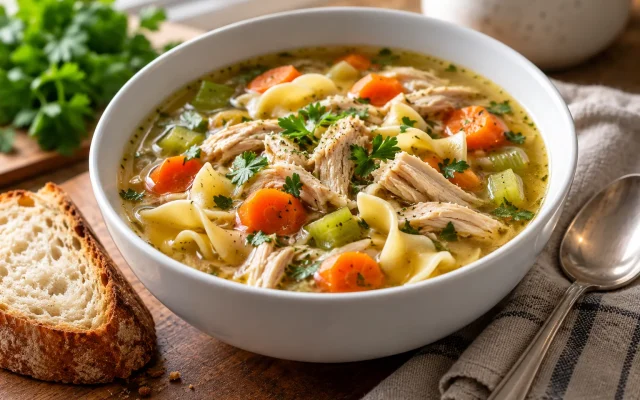
- Chicken noodle style: add cooked chicken and noodles, as in our homemade chicken noodle soup.
- Herbs: parsley stems, thyme or peppercorns add aroma.
- Vegetable-only version: skip the bones and simmer for a shorter time for a lighter stock.
- Ginger or garlic: add a slice or a clove for extra flavour.
Storage and food safety
The World Health Organization’s five keys to safer food include cooking thoroughly and keeping food at safe temperatures. For broth, that means cooling it quickly, refrigerating it in covered containers and using it within a few days, or freezing it in portions. When reheating, bring it to a full, steaming boil rather than just warming it.
Serving ideas
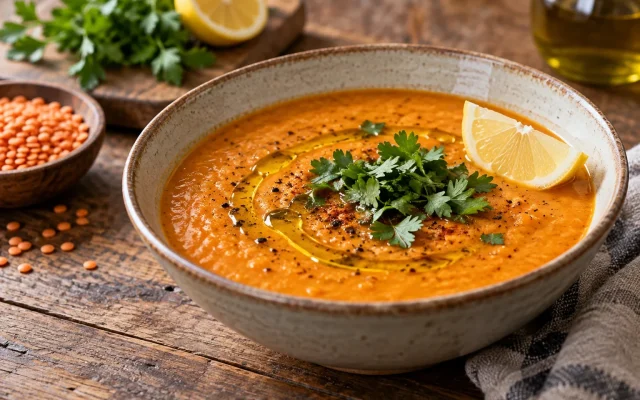
Serve it as a simple sip, or use it as the base for soups, rice and stews. For a hearty meal, try red lentil soup with lemon made with broth in place of water.
FAQ
Is bone broth healthier than regular broth?
It generally contains more protein, but the research on wider health benefits is limited, so enjoy it as a tasty food rather than a remedy.
How long should I simmer it?
Our recipe uses four to six hours at a gentle simmer. Longer is not necessarily better and the flavour can turn flat.
Why did my broth turn to jelly in the fridge?
That is normal. It is dissolved gelatin from the bones, and it melts back to liquid when heated.
Sources
- Savoring the benefits of bone broth: worth a taste? – Harvard Health Publishing, Harvard Medical School
- Collagen – The Nutrition Source, Harvard T.H. Chan School of Public Health
- Bone Broth: Benefits, How To Make and Nutrition – Cleveland Clinic
- Promoting safe food handling (Five keys to safer food) – World Health Organization
Recipe
Bone Broth Soup: A Simple Recipe and Honest Benefits
- Prep
- 15 min
- Cook
- 5 h
- Total
- 5 h 15 min
- Calories
- 62
Ingredients
Method
Simmer the bones with water and a splash of vinegar for 20 minutes, then drain.
Return the bones to the pot with vegetables and spices. Simmer gently for 4 to 6 hours.
Strain and season. Add cooked chicken and noodles if you like.
Tips
- Skim the foam in the first hour for a clearer broth.
- Those on a low-sodium diet should limit salt.
Nutrition per serving
- Calories
- 62
- Protein
- 7 g
- Carbs
- 7 g
- Fat
- 0.9 g
- Fiber
- 1.6 g
Estimated values, for information only.
Vitamins and minerals per serving
- Vitamin B1244%
- Vitamin A30%
- Zinc26%
Share of an adult’s daily value (FDA). Estimated from the main ingredients using USDA data, ignoring cooking losses; for information only. What do I need each day?

Comments