




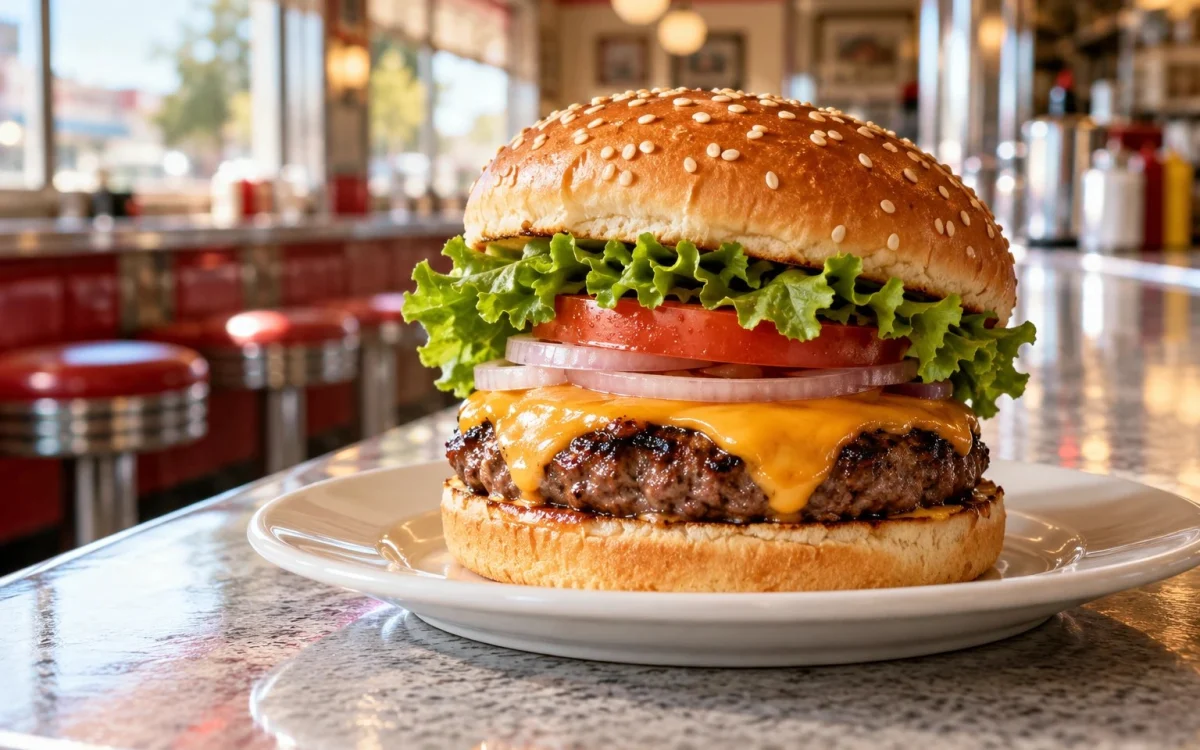
Who invented the hamburger? The honest answer is that nobody can prove it. Several American towns claim the honor, food historians have never found a dated receipt that settles the argument, and the dish that became the world’s most famous sandwich probably appeared in more than one place at about the same time. Here is the full story: where the idea came from, the rival claims, and how a lunch-counter sandwich became a global food.
Before the bun: the Hamburg steak
The story starts with the patty, not the bread. In the 1800s, German immigrants brought a dish called Hamburg steak to the United States, named after the port city of Hamburg where many of them sailed from. It was chopped or ground beef, seasoned and cooked, and it was eaten on a plate with a knife and fork. American restaurants and lunch wagons began to serve it, and soon sellers at fairs and workers’ lunch counters looked for ways to make it portable.
The real invention: putting it between bread
The new idea was simple: place the cooked patty between two pieces of bread so it could be eaten by hand, standing up or walking. That made it fast, cheap and easy to sell to crowds, which is why the earliest stories all happen at fairs, lunch stands and workers’ counters.
The five main claims
- Louis’ Lunch, New Haven, Connecticut (about 1900). The best-known claim. The small family-run lunch counter says owner Louis Lassen grilled a beef patty and placed it between two slices of toast for a hurried customer. The restaurant is listed among the Library of Congress “Local Legacies”, and it still cooks burgers in old vertical cast-iron broilers, on toast, with cheese spread, onion and tomato, and by tradition no ketchup.
- Seymour, Wisconsin (1885). Charlie Nagreen, a teenager selling meatballs at a fair, flattened them and put them between bread so people could walk while eating. Seymour calls itself the “Home of the Hamburger”.
- Hamburg, New York (1885). The brothers Frank and Charles Menches are said to have run out of pork sausage at a county fair and used ground beef instead.
- Tulsa, Oklahoma (1891). Oscar Weber Bilby is said to have served a ground beef patty on a bun.
- Athens, Texas (1880s to 1904). Fletcher “Old Dave” Davis is said to have sold burgers at his lunch stand and then at the 1904 World’s Fair in St. Louis.
Most of these accounts were first told decades later, often by family members, so they are hard to verify. That is why historians are careful: the most likely truth is that the idea appeared in several places around the same time.
How the burger became a national food
- 1904 World’s Fair. Crowds in St. Louis helped make hand-held ground-beef sandwiches known across the country.
- 1921: White Castle. The chain, founded in Wichita, Kansas by Walter Anderson and Billy Ingram, worked to make hamburgers look clean, standard and trustworthy at a time when many people doubted ground beef. It is often called the first fast-food hamburger chain.
- The cheeseburger. Several people in the 1920s and 1930s are credited with adding a slice of melted cheese, and the question of who did it first is just as disputed as the burger itself.
- Mid-20th century. The McDonald brothers’ fast, standardized kitchen system and Ray Kroc’s franchising in the 1950s spread the hamburger around the world.
Why the story still matters
The hamburger shows how many great foods are born: from a practical need (food you can eat on the move), from immigrants’ recipes, and from many cooks at once, not from a single genius. It also shows how food stories grow with time.
Make a classic burger at home
Try our juicy homemade burger or the herb-and-garlic Mediterranean burger. For the best texture, handle the meat as little as possible, use about 20% fat, and press a small dimple into the center so the patty cooks flat.
Frequently asked questions
Who invented the hamburger?
No one can be proven. Louis’ Lunch (New Haven, about 1900) is the best-known claim, with rival claims from Wisconsin, New York, Oklahoma and Texas.
Is the hamburger German?
The name comes from Hamburg, Germany, and the Hamburg steak from German immigrants, but the sandwich as we know it developed in the United States.
When did hamburgers become popular?
After the 1904 World’s Fair and especially after chains like White Castle (1921) and McDonald’s (1950s) made them cheap, fast and standard.
Sources
This article is general information, not medical advice. If you have a health condition, talk to your doctor or a registered dietitian.