



🔊 Cook mode: big steps, timers and voice control (say “next”), hands-free.
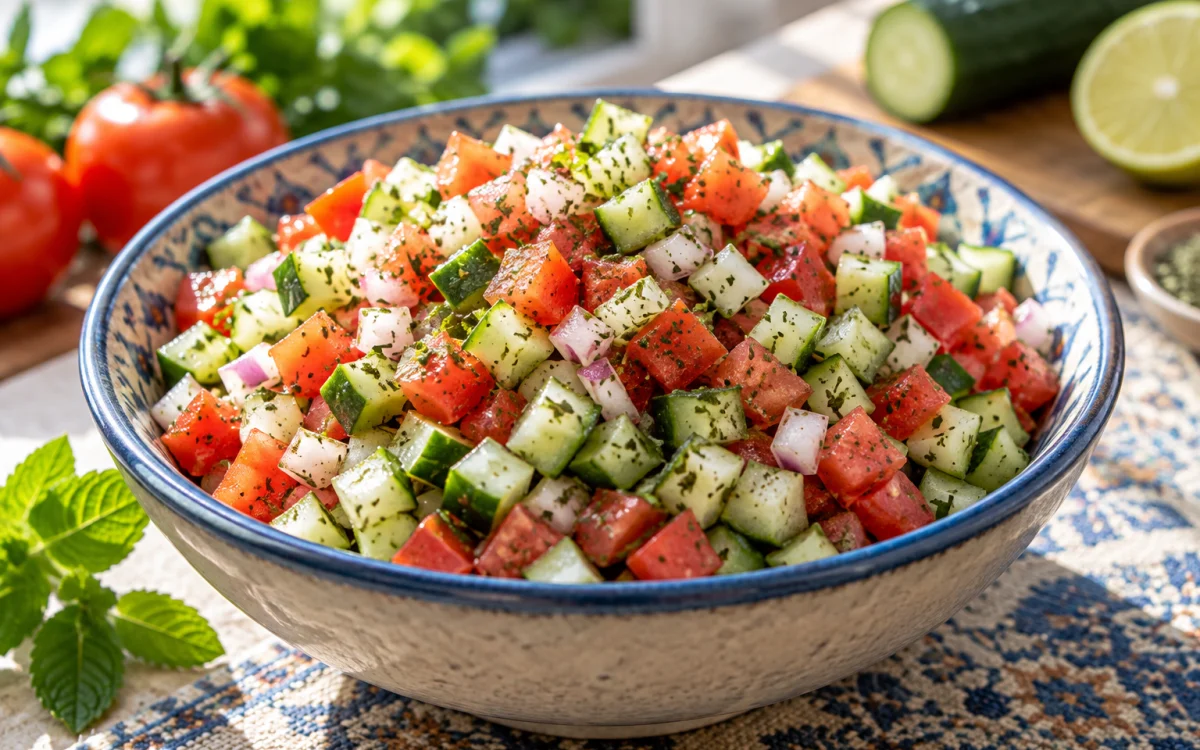
Shirazi salad (salad-e Shirazi) is the everyday Persian salad: finely diced cucumber, tomato and onion, dressed with lemon juice and salt. It is cool, crisp and sharp, which is exactly why it sits next to rich kebabs, rice and stews on so many Iranian tables. The ingredient list and method are in the recipe card above; this guide covers what makes the difference between a bright salad and a watery one.
Why it works
- Tiny, even cubes. Every spoonful carries all three vegetables, and the lemon juice reaches every piece.
- Acid and salt only. Without oil, the flavour of ripe tomato and cucumber stays clean and fresh, which is what cuts through grilled meat and rice.
- A short rest. Five to ten minutes lets the onion soften slightly and the juices mingle.
Tips for a better salad
- Choose ripe, firm tomatoes. Juicy but not mushy ones give flavour without turning the bowl into soup.
- Use thin-skinned or seedless cucumbers. If the seeds are large and watery, scoop them out.
- Soak the onion. If raw onion is too sharp for you, rinse the diced pieces in cold water for a few minutes and drain well.
- Salt late. Salt draws water out of the vegetables, so add it just before the short resting time and serve soon after.
- Taste the lemon. Add it gradually; lemons vary in sourness.
Common mistakes
- Cutting the vegetables into large chunks, which makes the salad feel more like a chopped-up side than Shirazi.
- Dressing it too early. After an hour or so it becomes watery.
- Using too much lemon or salt, which overpowers the vegetables.
Variations and substitutions
- Herbs: a little dried or fresh mint, or fresh parsley, is a common and delicious addition.
- Olive oil: a small drizzle gives a softer, rounder flavour, although the classic version has none.
- Verjuice or sour grape juice: some families use it in place of lemon for a gentler tartness.
- Onion: red onion is milder; white onion is sharper.
Health notes
This is a light, low-calorie salad made from vegetables that are largely water, so it is a refreshing side with a meal. It contains no added oil. Very large amounts of lemon juice can bother some people with sensitive stomachs, and salting heavily adds sodium, so season with a light hand.
Storage and make-ahead
You can dice the vegetables ahead and keep them separately in the fridge, then mix and dress them shortly before serving. Leftover dressed salad is best eaten within a few hours; drain off the liquid before serving again.
Serving ideas
Serve it beside Kebab Koobideh or Joojeh Kebab, with plain rice, or tucked into flatbread. For a leafy option, try our lettuce salad with lemon dressing.
A quick checklist before serving
Taste a spoonful and adjust: if it tastes flat, it usually needs a little more salt or lemon; if it tastes harsh, the onion may need rinsing or the lemon reducing. Check that the pieces are small and even, wipe the bowl rim, and serve the salad cold. Because the liquid at the bottom is full of flavour, many people spoon it over rice or dip bread into it rather than throwing it away.
FAQ
Is Shirazi salad the same as a Greek or Turkish salad?
They share ingredients, but Shirazi is cut much smaller and traditionally dressed with only lemon juice and salt.
How do I stop it from getting watery?
Seed the cucumber if needed, dice evenly, salt at the last moment and serve within a short time.
Can I add olive oil?
Yes. It is a modern variation; add a little at the end so the flavour stays fresh.
Rezept
Shirazi Salad (Authentic Persian Cucumber, Tomato, and Onion Salad)
- Vorbereitung
- 10 Min.
- Garzeit
- 10 Min.
- Gesamt
- 20 Min.
- Kalorien
- 45
Zutaten
Zubereitung
Wash all vegetables well. Finely dice cucumber, tomato, and onion into very small cubes.
Mix all ingredients in a bowl. Add lemon juice and salt. Mix gently. Let it rest for 5–10 minutes and serve fresh.
Tipps
- Cut everything very small and even
- Add lemon slowly and taste
- Serve immediately for best flavor
Nährwerte pro Portion
- Kalorien
- 45
- Eiweiß
- 1 g
- Kohlenhydrate
- 10 g
- Fett
- 0.2 g
- Ballaststoffe
- 2 g
Geschätzte Werte, nur zur Information.
Vitamine und Mineralstoffe pro Portion
- Vitamin C32%
- Vitamin K29%
Share of an adult’s daily value (FDA). Estimated from the main ingredients using USDA data, ignoring cooking losses; for information only. Was brauche ich täglich?