

🔊 Cook mode: big steps, timers and voice control (say “next”), hands-free.
Halva is the sweet that arrives at Persian gatherings when the nights turn long and cold. Made from just toasted flour, butter, sugar syrup, saffron and rose water, it is silky, fragrant and deeply comforting, which is why it has a natural place on the table for Yalda Night on December 21, and at winter condolence gatherings, celebrations and family teas across Iran. Making it a few weeks before Yalda lets you practise the texture and plan your table in good time.
What makes Persian halva different
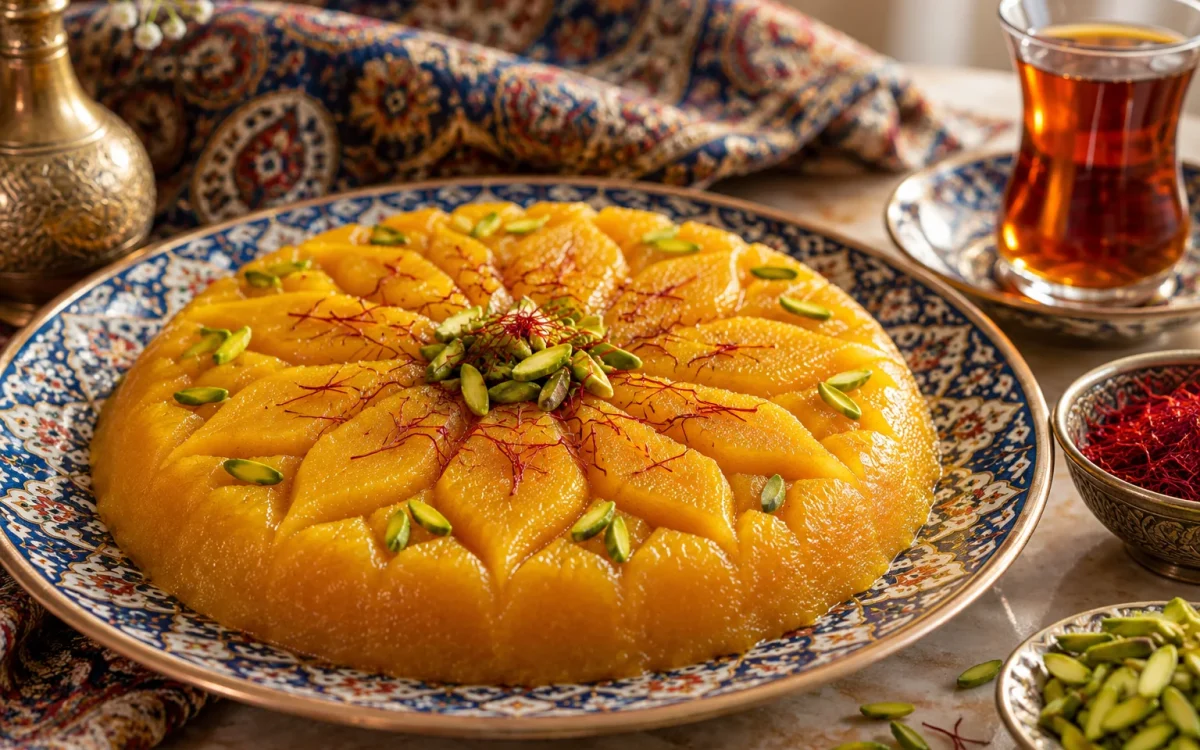
Unlike the dense tahini halva of the Levant or the semolina halva of Turkey, Persian halva (halva-ye zafarani) is built on a roux: flour slowly toasted in butter until it turns the colour of light caramel. That toasting step is the whole recipe. It gives the halva its nutty aroma and keeps it from tasting raw or pasty. A saffron and rose water syrup is then stirred in, and the mixture is cooked until it pulls away from the pan and turns glossy.
Tips for a smooth, glossy halva
- Sift the flour before toasting so no lumps form in the butter.
- Keep the heat low and stir constantly. The flour should go from pale to a soft golden brown. If it darkens too fast, lift the pan off the heat for a moment.
- Bloom the saffron properly. Grind it with a pinch of sugar and steep it in a few spoonfuls of hot water for at least 20 minutes for deep colour and aroma.
- Add the hot syrup slowly and away from your face. It will splutter when it meets the hot roux, so pour with a long spoon and keep stirring.
- Stop when it leaves the sides. Once the halva forms one soft mass that no longer sticks to the pan, it is done. Cooking longer makes it dry.
Shaping and decorating
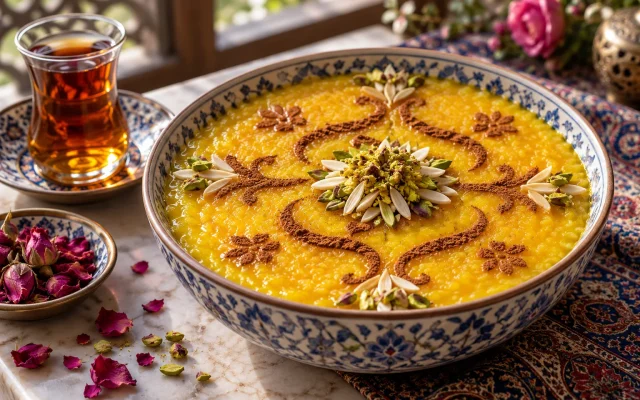
Press the warm halva into a shallow plate with the back of a spoon, then draw patterns with the spoon, a fork or a small glass base. Sprinkle with slivered pistachios, dried rose petals or a little ground cardamom. Some families spread it thinly like a pie; others shape it into a smooth mound. Both are traditional.
Variations
- Lighter version: replace part of the butter with neutral oil, which gives a softer, less rich result.
- Cardamom halva: add half a teaspoon of ground cardamom to the syrup.
- Date or sugar-reduced version: reduce the sugar by a quarter. The texture will be slightly less glossy but still pleasant.
- Dairy-free: use a plain oil or a dairy-free baking block instead of butter.
Serving ideas for Yalda Night
Serve small squares or spoonfuls with strong black tea, which balances the sweetness. On a Yalda table it sits happily beside pomegranate, watermelon, ajil (mixed nuts and dried fruit), persimmons and a fruit bowl, and it also goes well with plain cream or Persian clotted cream (sar-shir) on a warm piece of flatbread for breakfast.
Storage
Cover the halva and keep it at room temperature for up to 3 days, or in the fridge for up to a week. Warm gently for a few seconds before serving to bring back its softness. It also freezes well in portions for up to a month.
Note: halva is rich and sweet, so enjoy it in small portions. People managing blood sugar should check with their healthcare provider about sweets and portion sizes.
Recipe
Persian Saffron Halva (Halva Zafarani) for Yalda Night
- Prep
- 10 min
- Cook
- 35 min
- Total
- 45 min
- Calories
- 336
Ingredients
Roux
Syrup
Garnish
Method
Bring the sugar and water to a boil, simmer for 3 minutes, then stir in the bloomed saffron and rose water and keep the syrup hot.
Melt the butter in a wide, heavy pan over low heat.
Add the sifted flour and stir constantly for 15 to 20 minutes until it turns a soft golden brown and smells nutty.
Slowly pour in the hot syrup, stirring quickly, because it will splutter.
Keep stirring over low heat for 5 to 8 minutes until the halva forms a smooth mass that leaves the sides of the pan.
Press the halva into a plate, draw a pattern on top with a spoon, and sprinkle with pistachios.
Serve warm or at room temperature with black tea.
Tips
- Keep the heat low so the flour toasts evenly.
- Do not overcook, or the halva turns dry.
Nutrition per serving
- Calories
- 336
- Protein
- 2.4 g
- Carbs
- 43 g
- Fat
- 17.5 g
- Fiber
- 0.6 g
Estimated values, for information only.
Vitamins and minerals per serving
- Vitamin A16%
Share of an adult’s daily value (FDA). Estimated from the main ingredients using USDA data, ignoring cooking losses; for information only. What do I need each day?
Comments