




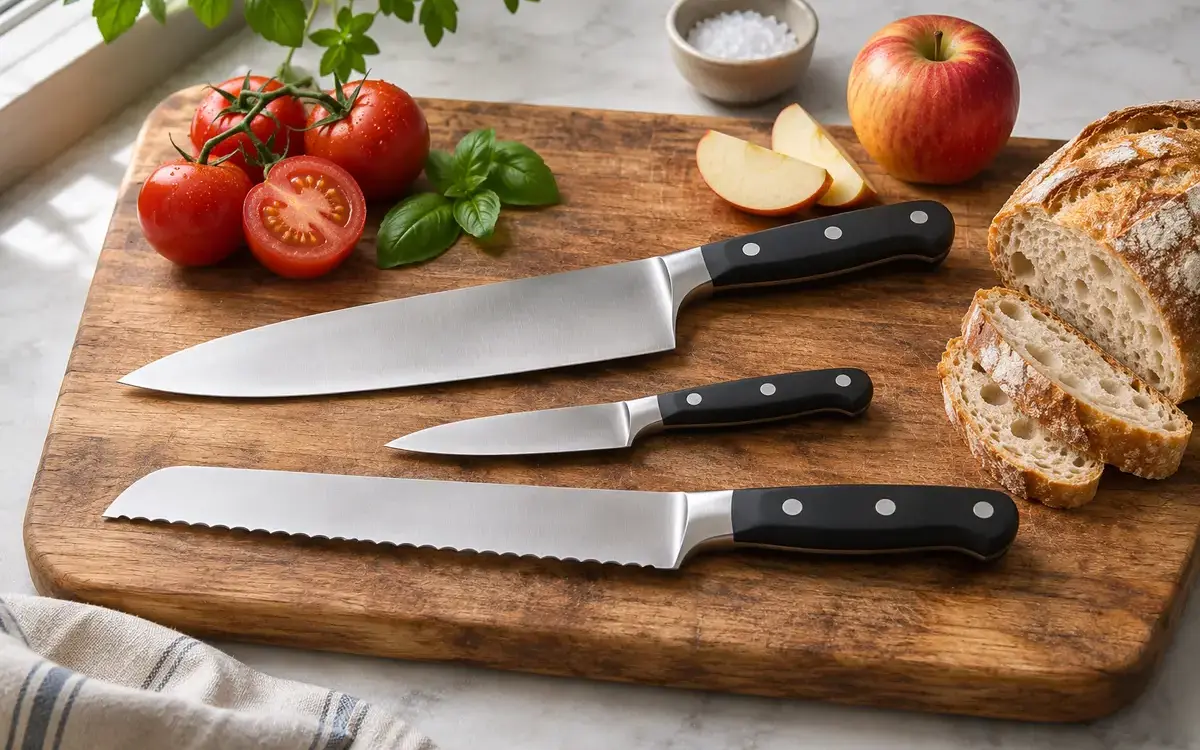
A knife block with fifteen blades looks impressive, but most home cooks use just three knives for nearly everything. Buying fewer, better knives saves money and makes cooking safer and faster. Here is what to get and how to care for it.
The three essential knives
First, an 8-inch chef knife does most of the work: chopping onions, slicing meat, mincing herbs and crushing garlic. Second, a serrated bread knife cuts crusty loaves, tomatoes and cakes without squashing them. Third, a small paring knife, around 3 to 4 inches, handles peeling, trimming and detail work in your hand.
What to look for
Choose a knife that feels balanced and comfortable in your hand, since fit matters more than brand. Forged or stamped steel can both work well. Look for a full tang, meaning the metal runs through the handle, and a handle that does not slip when wet. If you can, hold the knife in a store before you buy.
Hold it correctly
Use the pinch grip: pinch the base of the blade between your thumb and index finger and wrap the other fingers around the handle. Curl the fingertips of your other hand into a claw so the knuckles guide the blade and the tips stay safe.
Keep it sharp
- A sharp knife is safer than a dull one because it needs less force and slips less.
- Hone the blade on a honing steel before each use; this realigns the edge.
- Sharpen on a whetstone or with a sharpener a couple of times a year, depending on use.
- Wash by hand, dry immediately and store in a block, sheath or magnetic strip, never loose in a drawer.
Use a stable board
Place a damp towel under the cutting board so it does not slide. Wooden or plastic boards are gentler on edges than glass or stone.
Kommentare