





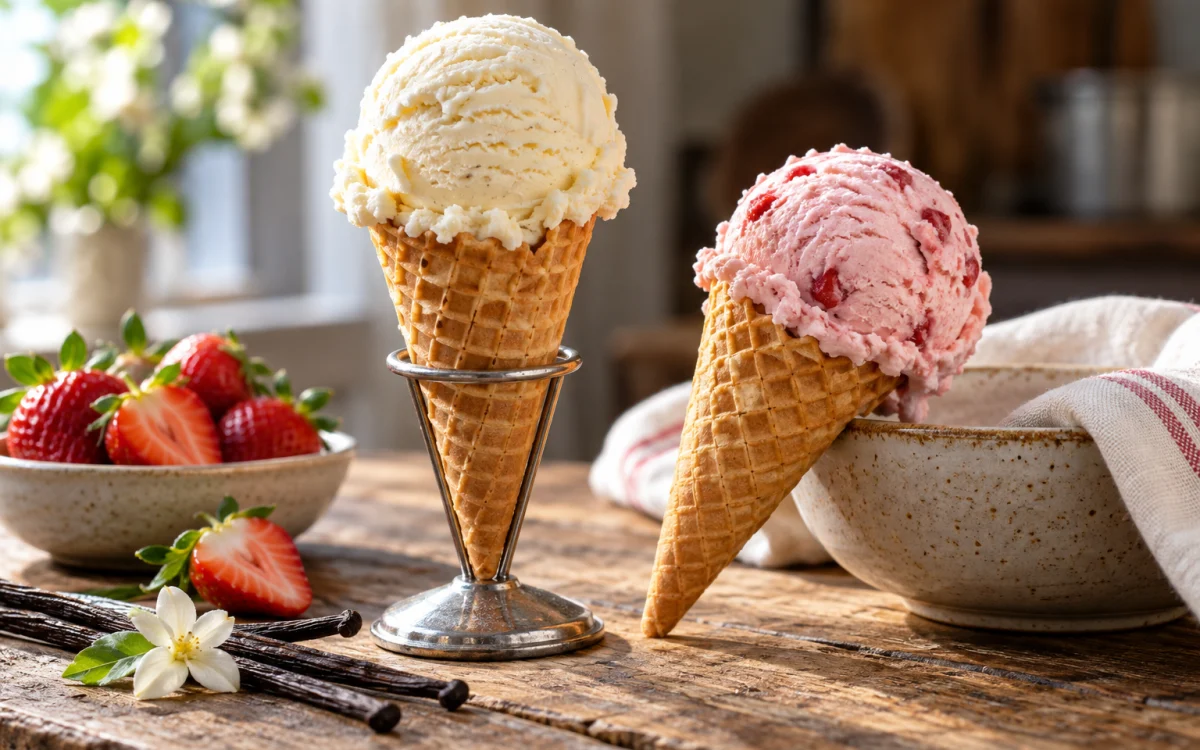
Who invented the ice cream cone? Like many famous foods, it has more than one inventor, and the popular story of a single moment at a world’s fair is only part of the history. Here is what we know about how the edible cone was born and how it went from fairground novelty to a summer essential.
Before the cone
In the 1800s, street sellers in Britain and the United States served ice cream in small glass cups called “penny licks”. Customers licked out the ice cream and handed the glass back, to be wiped and reused, which was far from hygienic. Edible holders solved that problem. Cookbooks in Europe already described rolled wafers and cornets filled with cream or ice cream in the 19th century, so the idea was not completely new.
Italo Marchiony’s patent
Italo Marchiony, an Italian immigrant who sold lemon ice and ice cream from a pushcart in New York, said he had been selling ice cream in edible cups since the 1890s. In December 1903 he received a U.S. patent for a mold that baked small, cup-shaped wafers with handles. His invention was closer to an edible cup than to the pointed cone we know today, but it is one of the earliest documented steps.
The 1904 St. Louis World’s Fair
The cone became famous at the 1904 Louisiana Purchase Exposition in St. Louis. Several vendors later claimed credit. The best-known story involves Ernest Hamwi, a Syrian immigrant selling a thin, waffle-like pastry called zalabia, who rolled one into a cone for a neighboring ice cream seller who had run out of dishes. Others, including Charles and Frank Menches and Abe Doumar, told similar stories. Historians agree that the cone was sold and popularized at the fair, but no single inventor can be proven.
From fair to factories
After 1904 the cone spread quickly. Bakeries began producing cones in large numbers, and in 1912 Frederick Bruckman of Portland, Oregon, patented a machine to roll cones automatically, which helped make them cheap and widely available. By the 1920s, millions of cones were being made each year in the United States.
Why the story matters
The ice cream cone is a good example of how food inventions usually happen: through gradual improvements, many people and a little luck, not one magical moment. It also solved a real problem, replacing reused glasses with a container you can eat.
A cool idea for home
Want a frozen treat without a freezer full of tubs? Try our story of the popsicle and make fruit pops at home with yogurt and berries.


Thank you so much for your thoughtful comment! You’re absolutely right—the story of the ice cream cone is a great example of how simple ideas, backed by creativity and timing, can evolve into something truly global. Without the industrial boom of the early 20th century, it’s hard to imagine the ice cream cone becoming such a widespread favorite. Mass production made it accessible to everyone, turning it from a novelty into a part of everyday dessert culture. And today, it’s not just a container—it’s a symbol of summertime, joy, and sweet memories. Amazing how far one crunchy idea can go!
Thank you for your thoughtful comment!
You’re absolutely right—it’s amazing how a seemingly simple dessert like the ice cream cone has such a layered and rich history. The 1904 St. Louis World’s Fair really did act as a turning point, showcasing new ideas to a global audience and helping push the cone into the mainstream.
As for how cones have changed over the years—yes, definitely! Early cones were more like thin wafers and sometimes quite fragile. Today’s cones come in all sorts of textures and flavors—from crispy sugar cones to softer cake cones, and even chocolate-dipped varieties. The quality and consistency have certainly improved thanks to modern production methods.
When it comes to credit, it’s hard to choose just one person. While Italo Marchiony was a key figure, it truly was a collaborative evolution. The innovation spread rapidly thanks to many creative minds, each adding a new twist.
And yes, without events like the World’s Fair, it might’ve taken much longer for the ice cream cone to catch on. Public exposure on that scale was crucial!
Personally, I love classic sugar cones with a chocolate coating inside—it’s nostalgic and delicious. And yes, I think the cone is still evolving—now we even see gluten-free, vegan, and artistic cones filled with everything from gelato to sushi rolls!
Thanks again for joining the conversation
Thank you so much for this interesting and enthusiastic comment!
You’re absolutely right—the 1904 St. Louis World’s Fair was a significant and influential moment in the history of food. Just imagining that first experience of eating ice cream in a cone is truly exciting!
The early ice cream cones usually had a more brittle texture and were less sweet. Over time, the recipes evolved to improve both flavor and durability. That’s why today’s cones have reached a more refined level in terms of quality and taste.
Personally, I prefer the classic sugar cone—it’s both delicious and sturdy, perfect for holding a scoop of ice cream.
Thank you for your comment. We appreciate your feedback and are glad you enjoyed our content.