

🔊 Cook mode: big steps, timers and voice control (say “next”), hands-free.
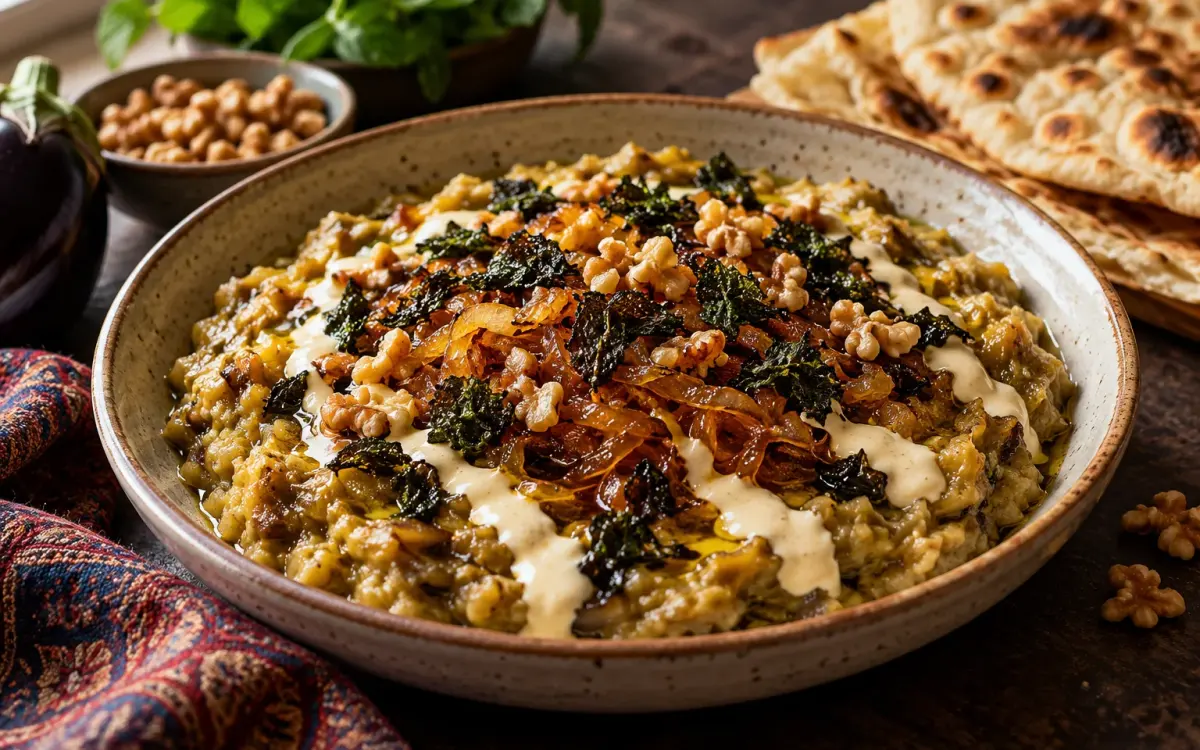
Kashk-e bademjan is a warm, creamy Persian dip made from roasted or fried eggplant, garlic and kashk, a tangy fermented whey that tastes a little like a cross between sour cream and feta. It is topped with deeply golden onions, crisp fried mint and a drizzle of extra kashk. Think of it as Iran’s answer to baba ganoush, but richer, savoury and gently sour.
It is a classic on the Persian table for Yalda Night, the winter solstice feast on December 21, and it works just as well as a starter for any autumn or holiday menu. Scoop it up with warm flatbread, pita or sturdy crackers.
What is kashk, and where do I buy it?
Kashk is made from drained, dried yogurt or whey. You can find it as a thick liquid in bottles or jars at Middle Eastern and Persian grocers and online, usually labelled “kashk” or “liquid whey”. If you cannot find it, mix 3 tablespoons of thick plain Greek yogurt with 1 tablespoon of sour cream and a pinch of salt. The flavour is milder, but still delicious.
Tips for the best texture
- Cook the eggplant until completely soft. Undercooked eggplant tastes bitter and watery. It should collapse when pressed with a fork.
- Roast instead of frying for a lighter dip. Brush the slices with a little oil and roast until deeply browned, then drain on paper towels.
- Chop, do not blend. The traditional texture is rustic and a little stringy. A food processor turns it into a smooth purée, which is tasty but less authentic.
- Go slowly with the onions. Cook them over medium-low heat for 25 to 30 minutes until deep gold. Burnt onions taste bitter.
- Add kashk off the heat or on very low heat, as it can curdle if it boils hard.
- Taste before salting. Kashk is salty, so season at the end.
Variations
- Add a spoonful of toasted, crushed walnuts for crunch.
- Stir in a pinch of turmeric with the garlic, as many Persian cooks do.
- For a dairy-free version, use unsweetened plain coconut or cashew yogurt with a squeeze of lemon, although it will not taste exactly like the classic.
Serving ideas for Yalda Night or a holiday table
Serve kashk-e bademjan alongside a fresh pomegranate salad, a plate of herbs, radishes and feta, warm barbari or pita bread, and olives. It pairs beautifully with the rest of a Persian winter spread, such as fesenjan and jeweled rice.
Storage
Keep the dip in an airtight container in the fridge for up to 4 days. Reheat gently in a pan with a splash of water, and add fresh fried onions and mint just before serving. It is good cold too, and the flavours deepen overnight. Freezing is not recommended because of the kashk.
Note: this dish contains dairy. People with dairy allergies should avoid it or use the dairy-free swap above.
Recipe
Kashk-e Bademjan (Persian Eggplant Dip with Caramelized Onion)
- Prep
- 15 min
- Cook
- 1 h 10 min
- Total
- 1 h 25 min
- Calories
- 190
Ingredients
Topping
Topping
Method
Heat the oven to 425°F (220°C). Slice the eggplants lengthwise into thick slabs, brush with 3 tablespoons of oil and arrange on lined baking sheets.
Roast for 40 minutes, turning once, until deeply browned and completely soft. Drain on paper towels.
While the eggplant roasts, cook the onions in 3 tablespoons of oil over medium-low heat for 30 minutes, stirring often, until deep golden. Set half aside for topping.
Add the garlic and turmeric to the remaining onions and cook for 1 minute.
Chop the eggplant coarsely and add it to the pan. Cook for 5 minutes, mashing roughly with a spoon.
Reduce the heat to very low and stir in the kashk. Warm through for 2 minutes without boiling, then season with salt and pepper.
Warm 1 tablespoon of oil in a small pan, remove from the heat and stir in the dried mint for 10 seconds.
Spoon the dip into a shallow bowl and top with the reserved onions, the mint oil, walnuts and a drizzle of kashk. Serve warm with flatbread.
Tips
- Kashk is salty, so add salt only at the end.
- Roast the eggplant until fully soft to avoid bitterness.
Nutrition per serving
- Calories
- 190
- Protein
- 5 g
- Carbs
- 14 g
- Fat
- 14 g
- Fiber
- 5 g
Estimated values, for information only.
Vitamins and minerals per serving
- Vitamin E16%
Share of an adult’s daily value (FDA). Estimated from the main ingredients using USDA data, ignoring cooking losses; for information only. What do I need each day?



Comments