

🔊 Cook mode: big steps, timers and voice control (say “next”), hands-free.
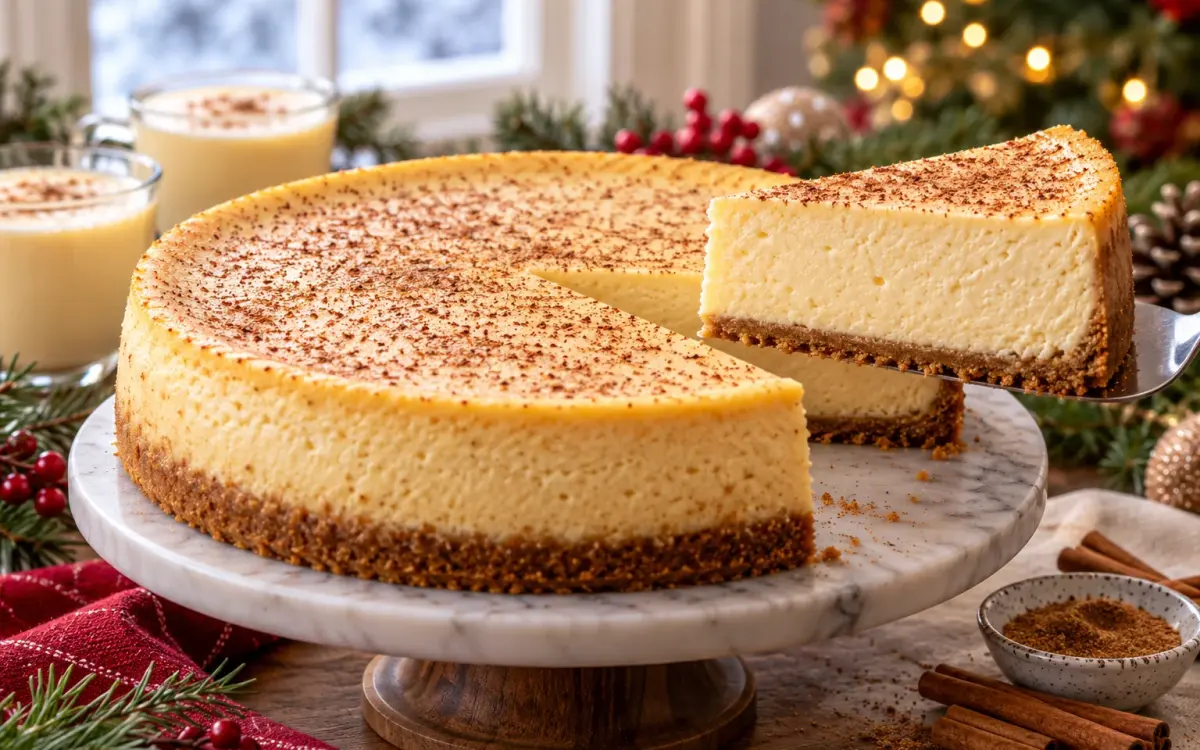
Eggnog is the flavour of December, and this cheesecake turns it into a dessert you can slice. Cooked-down eggnog gives a creamy, custardy filling with nutmeg and vanilla notes, set on a spiced graham or ginger-snap crust. Eggnog is a chilled, spiced drink of milk, cream, sugar and eggs, popular in the US, Canada and the UK around Christmas. It tastes like liquid vanilla custard with warm nutmeg.
It is also a true make-ahead dessert: it needs a full night in the fridge, so it frees your holiday day. Start the eggnog reduction while the cream cheese softens, and the rest comes together in one bowl.
Why reduce the eggnog?
Eggnog is mostly liquid, and too much liquid makes a cheesecake soft, pale and prone to cracking. Simmering 360 ml (1½ cups) down to about 120 ml (½ cup) concentrates the flavour and removes the extra water. Cool it completely before it meets the eggs.
Tips for a smooth, crack-free top
- Room-temperature ingredients. Cold cream cheese leaves lumps; take everything out of the fridge 1 hour ahead.
- Mix on low. Beat the cream cheese and sugar until smooth, then add eggs one at a time on low speed. Too much air causes puffing and cracks.
- Gentle bake. The centre should wobble like set gelatin when you tap the pan. It firms up as it cools.
- Cool slowly. Leave the cheesecake in the switched-off oven with the door ajar for an hour, then chill at least 6 hours, ideally overnight.
- Clean slices. Run a knife under hot water and wipe it between cuts.
Variations
- Rum or bourbon: stir in 1 tablespoon for a classic eggnog kick, or leave it out for a family-friendly version.
- Ginger-snap crust: swap the graham crackers for ginger biscuits (gingersnaps) for extra spice.
- Persian-inspired: replace the nutmeg with a pinch of cardamom and top with crushed pistachios and dried rose petals.
- Mini cheesecakes: bake in a lined muffin tin for 20 minutes.
Serving ideas for the holiday table
Top slices with whipped cream and a dusting of nutmeg, a spoonful of cranberry sauce, or a drizzle of salted caramel. It pairs well with coffee, spiced tea or a glass of sparkling cider alongside other make-ahead desserts such as a yule log or gingerbread cookies.
Storage
Keep covered in the fridge for up to 5 days. To freeze, chill fully, freeze whole or sliced on a tray, wrap well and keep for up to 2 months. Thaw overnight in the fridge. This dessert contains baked eggs, dairy, wheat and (if used) alcohol; check labels if you cook for guests with allergies, and use pasteurised eggnog.
Recipe
Eggnog Cheesecake for Christmas: Creamy and Make-Ahead
- Prep
- 25 min
- Cook
- 1 h 10 min
- Total
- 1 h 35 min
- Calories
- 470
Ingredients
Crust
Filling
Method
Heat the oven to 160°C (325°F) and line the base of a 23 cm (9 inch) springform pan with parchment.
Simmer the eggnog in a small pan over medium heat, stirring often, for about 15 minutes until reduced to 120 ml, then cool completely.
Mix the crushed crackers, melted butter and 2 tablespoons sugar, press firmly into the base of the pan and bake for 10 minutes. Let it cool slightly.
Beat the cream cheese, 150 g sugar and flour on low speed until completely smooth, scraping down the bowl.
Add the eggs one at a time, then the sour cream, reduced eggnog, vanilla, nutmeg and rum, mixing only until combined.
Pour the filling over the crust and bake for 55 to 60 minutes, until the edges are set and the centre still wobbles slightly.
Turn off the oven, prop the door open and leave the cheesecake inside for 1 hour.
Cool to room temperature, then chill covered for at least 6 hours or overnight before slicing.
Tips
- Use pasteurised eggnog and full-fat cream cheese for the best texture.
- Run a knife under hot water between slices for clean cuts.
- Keeps up to 5 days in the fridge or 2 months in the freezer.
Nutrition per serving
- Calories
- 470
- Protein
- 8 g
- Carbs
- 34 g
- Fat
- 34 g
- Fiber
- 1 g
Estimated values, for information only.
Vitamins and minerals per serving
- Vitamin A40%
- Vitamin B1224%
Share of an adult’s daily value (FDA). Estimated from the main ingredients using USDA data, ignoring cooking losses; for information only. What do I need each day?


Comments