

🔊 Cook mode: big steps, timers and voice control (say “next”), hands-free.
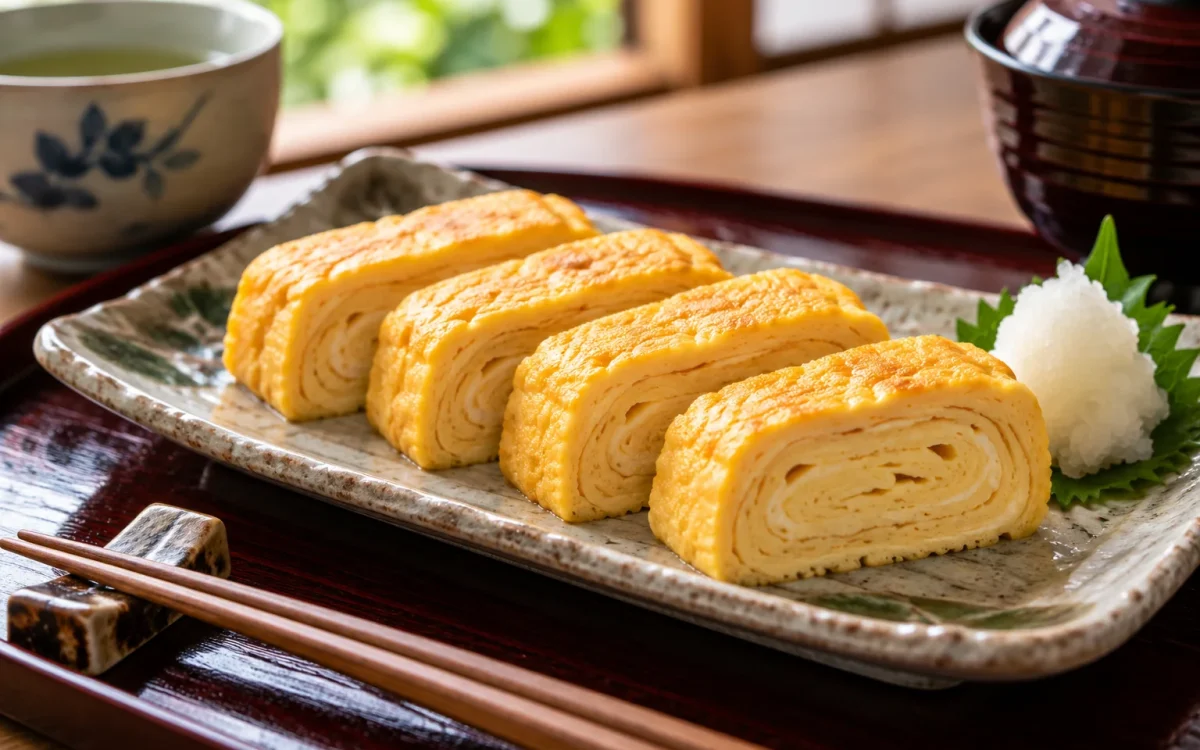
Tamagoyaki is the Japanese rolled omelette: thin layers of lightly sweet, savory egg folded into a soft, golden log and sliced into neat spirals. It tastes gently sweet and umami-rich, nothing like a fluffy diner omelette, and it is a staple of bento lunchboxes and sushi counters. Search interest in it keeps climbing because it looks impressive, uses only a few ingredients and is perfect for lunchbox and meal-prep season.
What makes it different
Instead of cooking one big omelette, you pour in a thin layer of egg, roll it up while it is still slightly wet, push it to one side, add more egg and roll again. Each layer fuses to the last, so the finished roll is tender and layered. The seasoning is a little soy sauce, a little sugar or mirin (a sweet Japanese rice wine; honey with a splash of water works in a pinch) and traditionally dashi, a light fish and kelp stock. Without dashi, plain water gives you a perfectly good result.
Tips for a smooth, golden roll
- Don’t over-whisk. Cut through the whites with chopsticks or a fork until just combined, then strain for a silky texture and no bubbles.
- Keep the heat medium-low. Brown spots are fine, but the egg should set gently, not crisp.
- Oil lightly, every layer. Wipe a folded paper towel dipped in oil across the pan between layers.
- Roll while the top is still glossy. A slightly wet surface glues the layers together.
- Rest it. Let the roll sit for a minute, wrapped in parchment or a clean towel, to firm up and even out its shape before slicing.
You don’t need a special pan. A small nonstick skillet works, although a rectangular tamagoyaki pan (cheap online or at Asian grocers) gives the classic square shape.
Variations
- Cheese tamagoyaki: lay a thin slice of cheese or a sprinkle of mozzarella inside before rolling.
- Scallion or nori: add finely chopped scallions, or a sheet of nori between layers for a spiral.
- Savory version: skip the sugar and add a pinch of salt and a little grated daikon on the side.
- Dashi-maki style: use more dashi for a juicier, more custardy roll.
Serving ideas
Serve slices warm with steamed rice and miso soup, tucked into a bento box, or packed in a sandwich with mayonnaise and crisp lettuce. It is also lovely on top of a rice bowl with sliced cucumber and sesame seeds.
Storage
Cool completely, then refrigerate in an airtight container for up to 2 days. It is good cold in lunchboxes and can be gently rewarmed in the microwave for 20 seconds. Eggs should be fully cooked, so keep it chilled until lunchtime and skip it for young children or anyone who needs to avoid eggs.
Recipe
Tamagoyaki (Japanese Rolled Omelette): Soft, Sweet and Easy
- Prep
- 5 min
- Cook
- 10 min
- Total
- 15 min
- Calories
- 205
Ingredients
Method
Crack the eggs into a bowl and add the water or dashi, sugar, soy sauce, mirin and salt.
Cut through the eggs with chopsticks or a fork until just combined, without whipping in air, then strain through a sieve for a smooth mixture.
Heat a small nonstick pan or tamagoyaki pan over medium-low heat and wipe it with a paper towel dipped in oil.
Pour in about a third of the egg and tilt the pan to coat the bottom, popping any bubbles.
When the surface is nearly set but still glossy, roll the egg toward you into a log.
Push the roll to the far side, oil the empty part of the pan, and pour in another third of the egg, lifting the roll so egg runs underneath.
Roll again when the top is nearly set, then repeat with the remaining egg.
Slide the omelette onto parchment or a clean towel, shape it gently and let it rest for one minute.
Slice into rounds and serve warm or cold.
Tips
- Keep the heat medium-low so the egg stays tender and golden.
- Strain the egg mixture for the silkiest texture.
- Cool completely before packing into a lunchbox and eat within two days.
Nutrition per serving
- Calories
- 205
- Protein
- 13 g
- Carbs
- 5 g
- Fat
- 14 g
- Fiber
- 0 g
Estimated values, for information only.



Comments