

🔊 Cook mode: big steps, timers and voice control (say “next”), hands-free.
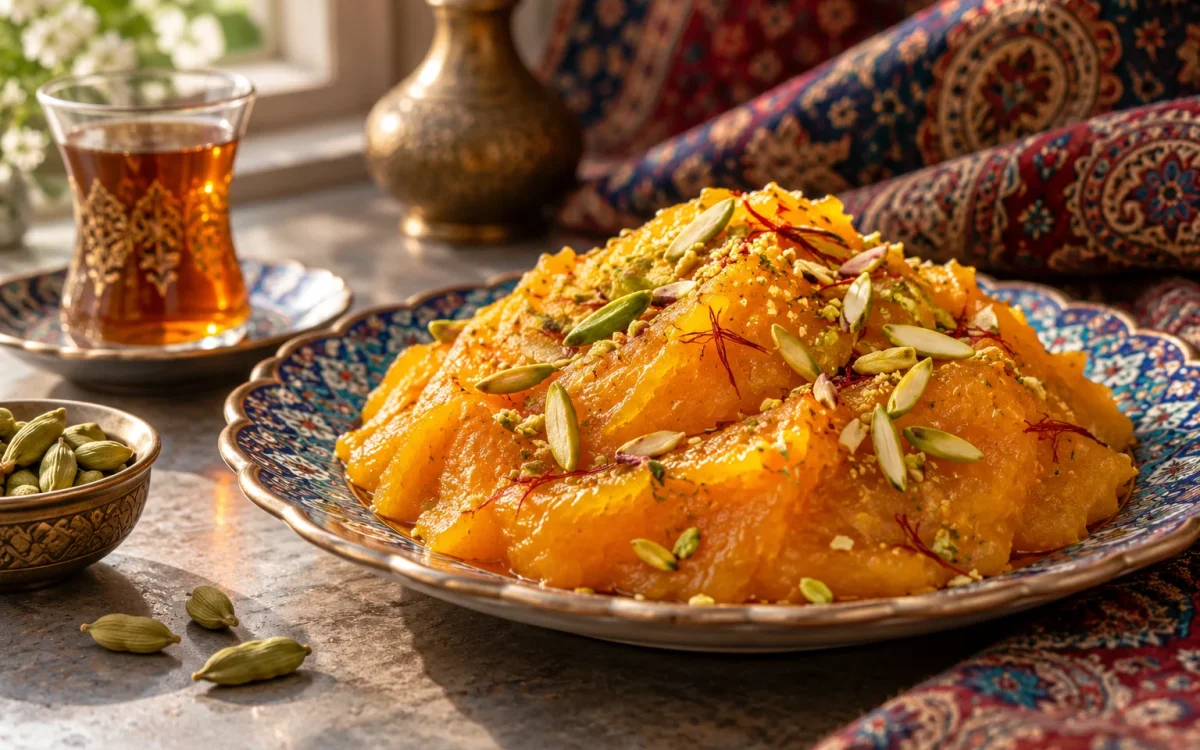
Halva kaddu is a soft, spoonable Persian pumpkin sweet scented with saffron, cardamom and rose water. It is a quiet cousin of the better-known flour and oil halvas: naturally gluten-free, only lightly sweet, and made from a vegetable that is at its best right now. With Yalda Night on December 21, it is a lovely addition to the table beside pomegranates, watermelon and nuts, and it works just as well as a cosy autumn dessert with tea.
Choosing the right pumpkin
The success of this halva depends on the pumpkin. Pick a dense, sweet, deep orange variety such as butternut squash, kabocha or sugar pumpkin. Large carving pumpkins are watery and stringy, and they take far longer to cook down. A good pumpkin should feel heavy for its size. If you only need a small batch, a 1 kg squash gives about 700 grams of peeled flesh, which is exactly what you need.
Tips for a silky texture
- Steam rather than boil. Steaming keeps the flesh from absorbing extra water, so the halva thickens faster and tastes more concentrated.
- Mash very smooth. A potato masher works, or pulse briefly in a food processor. Lumps will not disappear later.
- Cook slowly, stir often. The mixture should sizzle gently, never scorch. Medium-low heat and a wide, non-stick pan give the best result.
- Add sugar after the pumpkin has darkened. The pumpkin is already naturally sweet, and cooking it first deepens the flavour. Taste before adding all the sugar.
- Bloom the saffron. Grind it with a pinch of sugar and steep in a few tablespoons of hot water for ten minutes so its colour and aroma spread evenly.
- Know when it is done. The halva is ready when it pulls away from the sides of the pan and a spoon drawn across the bottom leaves a clear trail.
Variations
For a dairy-free version, use a neutral oil or coconut oil instead of butter. A spoonful of ground ginger or a little orange zest gives a fresher, brighter note. Some cooks fold in a handful of ground walnuts or almonds for body, and others replace part of the sugar with honey or date syrup. If you like a richer, more traditional flavour, brown the butter lightly before adding the pumpkin.
Serving ideas for Yalda Night
Serve warm in small bowls or press into a shallow dish and cut into diamonds once cooled. Decorate with slivered pistachios, a dusting of cinnamon and a few pomegranate seeds for a festive finish. On a Yalda menu it pairs well with fresh fruit, ajil, a pot of hot black tea and a bowl of pomegranate and walnut salad. It also makes a gentle ending after a rich dish such as fesenjan.
Storage
Keep the halva in an airtight container in the refrigerator for up to five days. Reheat gently in a pan or microwave with a splash of water, or enjoy it cold and firm. It freezes well for up to two months; thaw overnight in the refrigerator. Because it is made from fresh vegetable puree, do not leave it at room temperature for more than a couple of hours.
Recipe
Halva Kaddu: Persian Pumpkin Halva with Saffron and Cardamom
- Prep
- 15 min
- Cook
- 50 min
- Total
- 1 h 5 min
- Calories
- 135
Ingredients
Method
Steam the pumpkin cubes for about 15 minutes until completely soft, then drain well.
Mash the pumpkin until perfectly smooth.
Melt the butter in a wide non-stick pan over medium-low heat and add the mashed pumpkin.
Cook for about 20 minutes, stirring often, until the puree thickens and darkens slightly.
Stir in the sugar and cook for 10 more minutes until the mixture is glossy and thick.
Add the saffron water, cardamom and rose water and cook for 5 minutes, until the halva pulls away from the sides of the pan.
Spoon into a serving dish, dust with cinnamon and scatter the pistachios on top. Serve warm or cold.
Tips
- Use a dense sweet squash rather than a large carving pumpkin.
- Steam instead of boiling so the puree stays thick.
Nutrition per serving
- Calories
- 135
- Protein
- 2 g
- Carbs
- 19 g
- Fat
- 7 g
- Fiber
- 1 g
Estimated values, for information only.
Vitamins and minerals per serving
- Vitamin A57%
- Vitamin C21%
Share of an adult’s daily value (FDA). Estimated from the main ingredients using USDA data, ignoring cooking losses; for information only. What do I need each day?
Comments