

🔊 Cook mode: big steps, timers and voice control (say “next”), hands-free.
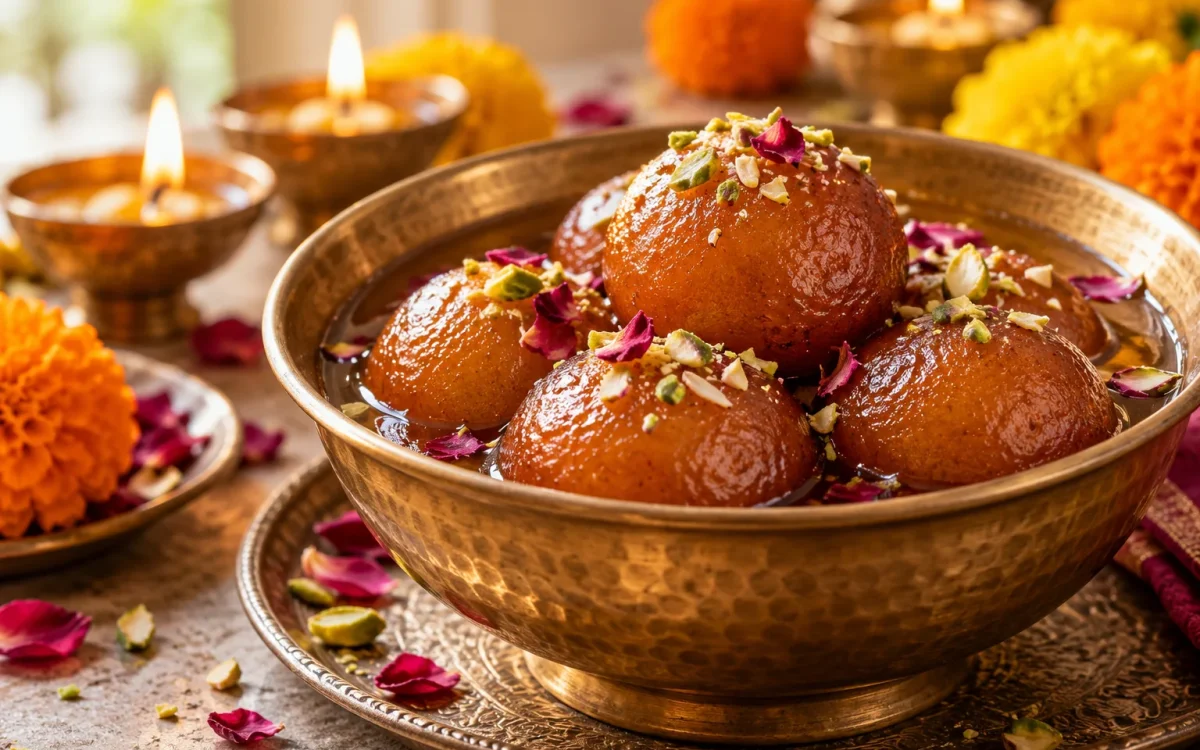
Gulab jamun are small, golden dumplings made from milk solids, fried gently and soaked in a warm syrup scented with cardamom and rose. They are one of India’s best-loved sweets, served at weddings, festivals and family gatherings, and they are at the heart of the Diwali table. With Diwali arriving on November 8 this year, now is a great time to practise. The texture is the whole point: tender, spongy and syrupy all the way through, like a very soft doughnut hole that has melted a little around the edges.
What you need to know before you start
Traditional gulab jamun use khoya (reduced milk solids), which is hard to find outside South Asian shops. This version uses full-fat milk powder, sold in most supermarkets and online, and gives very close results. Ghee is clarified butter; if you cannot find it, use neutral oil with a spoonful of melted butter in the dough. Rose water is sold in the baking or international aisle and in Middle Eastern shops.
Tips for soft, never-hard dumplings
- Knead gently. Mix only until the dough comes together and feels smooth. Overworking makes dense, hard jamun.
- Roll cracks-free. Oil your palms and roll each portion until the surface is completely smooth. Cracks open up in the oil and the ball can break apart.
- Fry low and slow. The oil should be only gently warm when the balls go in (around 300°F / 150°C). Move them constantly with a spoon so they brown evenly. They will swell to about twice their size.
- Warm syrup, warm jamun. Drop the fried balls into warm, not boiling, syrup. If the syrup is too hot or too thick they stay hard in the centre; if the jamun are cold, they soak poorly.
- Be patient. Let them soak for at least an hour. They improve overnight.
Variations
- Stuffed: press a pistachio sliver, a raisin or a pinch of crushed nuts into the centre of each ball.
- Saffron: steep a generous pinch of saffron in the syrup for a floral, golden version that echoes Persian desserts.
- Baked-style shortcut: if you prefer not to fry, jamun can be cooked in an air fryer at low heat with a little ghee brushed on, though the crust is paler and the texture slightly less rich.
Serving ideas for a Diwali table
Serve gulab jamun warm, with a little syrup spooned over, topped with chopped pistachios or dried rose petals. For a festive dessert spread, pair them with pistachio barfi, saffron kheer or a simple platter of dried fruit and nuts. They are also lovely with a scoop of vanilla ice cream, a favourite way to serve them in restaurants.
Storage
Keep the jamun in their syrup in a covered container in the fridge for up to five days. Warm them in the microwave for 15 to 20 seconds before serving. You can also fry the balls ahead and soak them on the day. Freezing is not recommended because the texture turns spongy.
Note: this is a rich, sugary dessert, best enjoyed in small portions. If you are managing blood sugar, keep to one or two pieces and check with your doctor or dietitian about what suits you.
Recipe
Gulab Jamun: Soft Indian Milk Dumplings in Rose Syrup for Diwali
- Prep
- 20 min
- Cook
- 30 min
- Total
- 50 min
- Calories
- 260
Ingredients
Dumplings
Syrup
Method
Make the syrup: simmer the sugar, water and cardamom for 8 minutes until lightly sticky, then stir in the saffron, rose water and lemon juice and keep warm.
Mix the milk powder, flour and baking powder in a bowl, then rub in the melted ghee.
Add the warm milk a spoonful at a time and bring the mixture into a soft, smooth dough without kneading hard, then rest it for 5 minutes.
With lightly oiled palms, roll the dough into 20 smooth, crack-free balls.
Heat the ghee or oil over low heat to about 300°F (150°C) and fry the balls in batches, turning constantly, for 8 to 10 minutes until deep golden brown.
Drain briefly and drop the balls into the warm syrup.
Soak for at least 1 hour before serving, warm, with chopped pistachios.
Tips
- Keep the oil on low heat so the centres cook through.
- Soak in warm syrup, never boiling, so the dumplings stay soft.
Nutrition per serving
- Calories
- 260
- Protein
- 5 g
- Carbs
- 40 g
- Fat
- 9 g
- Fiber
- 0 g
Estimated values, for information only.
Comments